
New program will create a centralized hub connecting Arkansans with energy savings, assistance, financing, training and career opportunities
The Arkansas Advanced Energy Foundation (AAEF) today announced the launch of the Arkansas Energy Navigator Program, a new initiative designed to connect Arkansans with energy savings, financial assistance, workforce training, career opportunities and other resources that can strengthen economic mobility. AAEF has also hired Cynthia Perez as Programs Coordinator to help develop and oversee the program.
“The goal is simple: make Arkansas’s energy resources easier to find, easier to access and more effective at creating economic opportunity,” Perez said. “There is no single path that works for every household, worker, business or community. We want to help Arkansans identify where they want to go and connect them with the resources that can help them get there.”
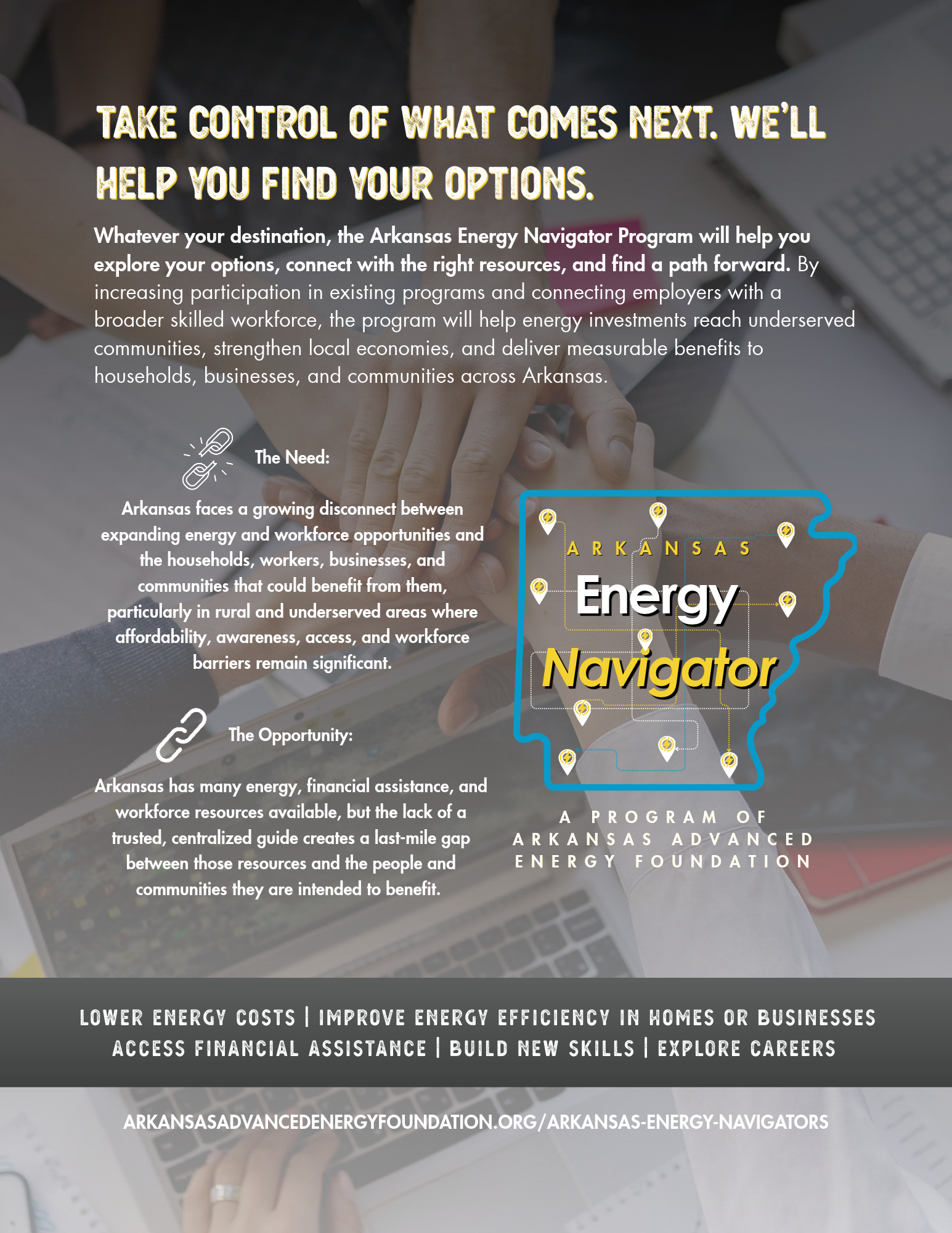
Arkansas has significant energy and workforce resources available but lacks a centralized information hub for those in need of the resources. Utility rebates, energy assistance, financing programs, workforce training and career opportunities are often spread across different organizations and systems. For households, businesses and communities - particularly in rural and underserved areas - limited awareness, administrative complexity and a lack of trusted guidance can prevent those resources from reaching the people they are intended to benefit.
Energy affordability is a particularly acute and immediate challenge for many Arkansas households. An estimated 43 percent of Arkansas households are considered below the ALICE (Asset Limited, Income Constrained, Employed) threshold. Low- and moderate-income households spend approximately 6–10 percent of their monthly income on energy bills, significantly higher than the national average (Southeast Energy Efficiency Alliance, 2026). This elevated energy burden is driven in part by aging, inefficient housing stock and limited access to energy efficiency upgrades, contributing to persistent financial strain and limiting household economic mobility.
At the same time, employers in energy, construction, advanced manufacturing and related trades continue to report workforce needs in industries critical to the state's economic growth. The state’s labor force participation rate is 58.4 percent, below national averages, while employers in construction, energy, and advanced manufacturing continue to report significant hiring shortages (Bureau of Labor Statistics, 2025).
Administered by AAE with support from the Arkansas Community Foundation, Americorps, and private funders, the Energy Navigator Program is designed to help close those gaps.
“We are an industry intermediary, so we didn’t set out to create a navigation program. The need became clear because Arkansans kept coming to us for help finding energy resources, even before we offered that service. As a trusted resource for the industry and our communities, we recognized an opportunity to turn those individual requests into a more coordinated, statewide effort that helps people connect with the resources and opportunities already available to them.”
As Arkansas’s energy industry intermediary, AAEF will build a statewide navigator model connecting individuals, businesses and communities with utilities, contractors, educators, workforce organizations and other partners.
The program will focus on:
Connecting resources: Creating a centralized source for energy savings, assistance, financing, training and workforce opportunities.
Creating clear pathways: Helping individuals and businesses identify and connect with programs that meet their specific needs.
Reaching communities: Providing accessible education and direct navigation, particularly in rural and underserved areas.
Coordinating partners: Strengthening connections among utilities, contractors, employers, educators, workforce organizations and community partners.
Building statewide infrastructure: Developing tools and processes that make energy and workforce resources easier to access across Arkansas.
Through this work, AAEF aims to strengthen economic mobility of individuals and businesses by increasing participation in existing energy efficiency and workforce programs, improving access to energy savings and affordability resources, expanding awareness of advanced energy careers, and strengthening the talent pipeline for Arkansas employers.
The Energy Navigator Program is currently in its planning and development phase, and AAEF is seeking input from Arkansans and community partners about the resources they would like to see included in the Navigators Program. Those interested in participating, partnering, or receiving program updates can visit the Arkansas Energy Navigator page at www.arkansasadvancedenergyfoundation.org/arkansas-energy-navigators.

Perez is a Master of Public Administration graduate passionate about advancing equitable community development and empowering underserved populations. With experience in outreach, program development, and nonprofit consulting, she has worked to build meaningful partnerships and expand access to critical resources. She previously served as Engagement and Opportunity Specialist for the City of Little Rock after an economic development and outreach internship with the Port of Little Rock. Prior to that, she used her bilingual skills as Director of Programs for Rise House, Partnerships Account Executive for Reloshare, and Criminal Defense and Traffic Paralegal for the Tellez Law Firm.
“I look forward to continuing my career in public service, where I can drive sustainable change and uplift communities through strategic engagement and innovative solutions,” Perez said.
She earned her Master of Public Administration from the University of Arkansas at Little Rock and holds a Bachelor of Arts in Political Science from Henderson State University. She also has certificates in Conflict Management and Non Profit Management from the University of Arkansas at Little Rock.